Blog
What a Proprietary Blend Hides: Reading the 15.47 mg Blend in Hawaiian Harmony
A proprietary blend shows a total weight and lists its ingredients from most to least by weight, but it does not have to give single amounts (FDA, Labeling guide). Hawaiian Harmony's blend weighs 15.47 mg for 21 ingredients, about 0.74 mg each on average. Studied amounts of gymnema, African mango and L-carnitine run to hundreds of milligrams or more. The panel is published, which is a real strength.
The basics
What is a proprietary blend on a supplement label?
A proprietary blend is a group of ingredients listed under one name with one total weight. The maker keeps the recipe private by not printing how much of each one goes in.
Companies say blends protect a formula from copycats. For a shopper, though, a blend removes the number that matters most: how much of each ingredient you get.
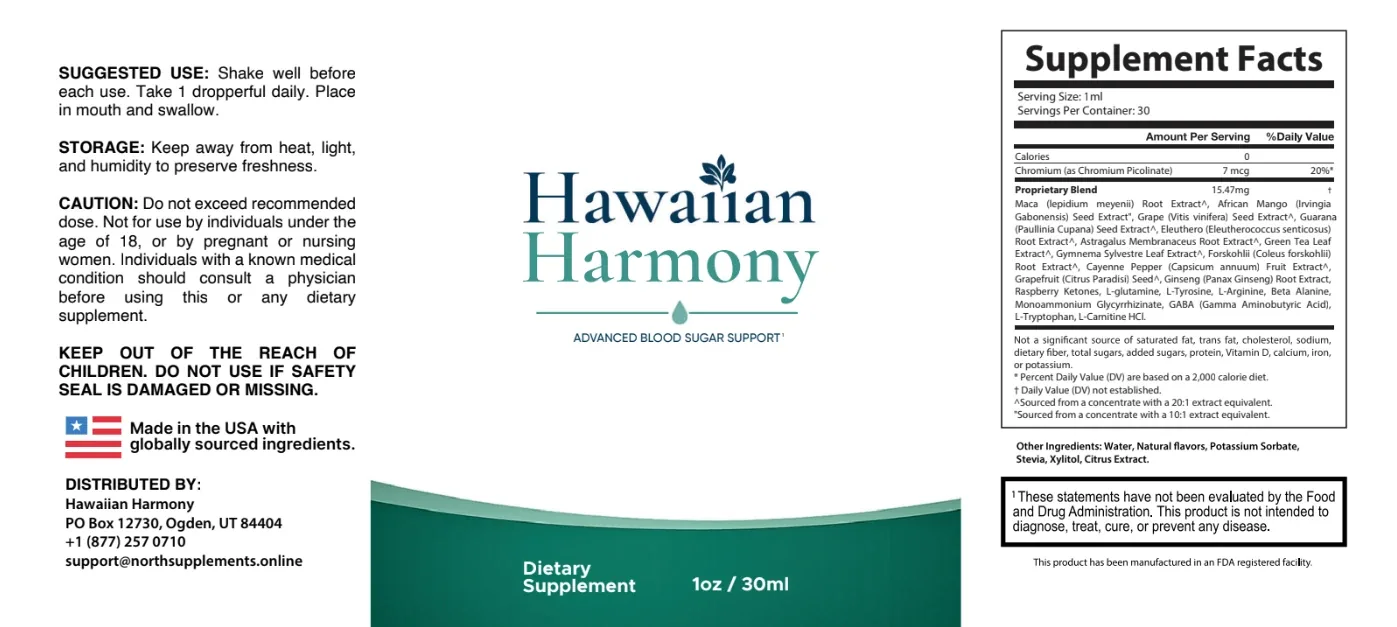
Hawaiian Harmony uses a blend. Its Supplement Facts panel lists chromium on its own line, then a "Proprietary Blend" of 15.47 mg with 21 names under it. The label calls the product "Advanced Blood Sugar Support". That is the label's claim, and no study of the product backs it.
The rules
What do FDA rules require a blend to show?
FDA labeling rules require a blend to show its total weight and to list its ingredients in order of weight, from most to least (FDA, Labeling guide). Single amounts are not required.
- Total weight: the blend's combined weight per serving must appear.
- Order: ingredients run from the heaviest to the lightest.
- Single amounts: optional, so most blends leave them out.
- Nutrients with a Daily Value: these, like chromium, must show their own amount.
That last rule is why Hawaiian Harmony prints chromium as 7 mcg (20% DV). Our post on chromium and blood sugar explains what that amount means.
A blend that follows every rule can still leave you unable to compare it with research. Keep those two questions apart when you read a label.
Label order
What does label order tell you about the Hawaiian Harmony blend?
Label order sets a ceiling on every ingredient. Each one weighs no more than the one listed before it, so the 8th ingredient can weigh at most one eighth of the total.
That simple rule turns a hidden recipe into hard upper limits. The table applies it to 15.47 mg.
| Label position | Ingredient | Most it could weigh |
|---|---|---|
| 1 | Maca root extract | 15.47 mg (only if it were the whole blend) |
| 2 | African mango seed extract | 7.7 mg |
| 4 | Guarana seed extract (a caffeine source) | 3.9 mg |
| 7 | Green tea leaf extract | 2.2 mg |
| 8 | Gymnema leaf extract | 1.9 mg |
| 9 | Coleus forskohlii root extract | 1.7 mg |
| 12 | Asian ginseng root extract | 1.3 mg |
| 18 | Monoammonium glycyrrhizinate (licorice compound) | 0.86 mg |
| 21 | L-carnitine HCl | 0.74 mg |
These are ceilings, not estimates. The real split is unknown. See every line in the Hawaiian Harmony Supplement Facts.
The math
How small is a 15.47 mg blend split 21 ways?
Extract marks
What do the 20:1 and 10:1 marks on the label mean?
A 20:1 mark means about 20 parts of raw plant were used to make 1 part of extract. So 1 mg of a 20:1 extract stands for roughly 20 mg of the dried plant.
On the Hawaiian Harmony label, a ^ marks 11 plant ingredients, grapefruit seed included, as "sourced from a concentrate with a 20:1 extract equivalent". A ° marks African mango as 10:1.
- They tell you how much raw plant went into the extract.
- They do not tell you how much of any active compound is in it.
- They do not make the extract 20 times as effective.
Take gymnema. At its 1.9 mg ceiling, a 20:1 ratio equals about 38 mg of raw leaf. The typical studied dose is 400 mg of gymnema taken three times a day (LiverTox, Gymnema). Those studies used extracts too, so the ratio does not close the gap.
Dose scale
How does the Hawaiian Harmony blend compare with research doses?
It sits far below them. Even if one ingredient took the whole 15.47 mg, it would reach only a small share of studied amounts.
-
Chromium(ODS, Chromium)0.7%of the studied amount
-
Gymnema leaf(LiverTox, Gymnema)at most 1.3%of the studied amount
-
African mango seed(ODS, Weight-loss supplements)at most 5.2%of the studied amount
-
Coleus forskohlii(ODS, Weight-loss supplements)at most 3.1%of the studied amount
-
L-carnitine(ODS, Weight-loss supplements)at most 0.86%of the studied amount
Bars are to scale. For blend ingredients we use the whole 15.47 mg, the most any one ingredient could be. The label marks most plant extracts as 20:1 concentrates, so the raw-plant equivalent is higher. The studies above also measured extracts or pure compounds, not raw plant.
Research on a single ingredient tests that ingredient, often alone and at a much higher dose. It does not test Hawaiian Harmony, and no trial of the finished product exists. The Hawaiian Harmony ingredients page covers what each of the 21 names is.
Fair credit
What does the Hawaiian Harmony label get right?
It publishes the full panel. Many products hide theirs, so that is a real strength.
What the label shows
- A full Supplement Facts panel
- The blend's total weight, 15.47 mg
- All 21 names in weight order
- Chromium stated as 7 mcg
- Extract ratios marked with symbols
- Other ingredients, including xylitol
What it leaves out
- Any single blend amount
- Caffeine per serving
- The licorice compound's amount
- What the extracts are standardized to
- A study of the product itself
Questions
What should you ask the seller about the blend?
Ask for the numbers the label leaves out. Write through the contact page on the official sales site and keep the replies with your order email.
Ask for key single amounts
Request the milligrams of gymnema, African mango and ginseng per 1 ml. These are the names most tied to blood sugar research.
Ask for caffeine per serving
Guarana and green tea both supply caffeine. The total is small inside 15.47 mg, but it is not printed.
Ask about the licorice compound
Glycyrrhizin can affect heart rhythm in large or long-term amounts (NCCIH, Licorice root). Ask how much monoammonium glycyrrhizinate one serving holds.
Ask what the extracts are standardized to
A ratio shows raw plant used. A standardized percent shows the active compound. Ask for the percent if one exists.
Ask for a lab report
The lot and CoA codes on this site are seller references, not lab proof. See batch verify for what they can and cannot show.
Bottom line
Should a proprietary blend stop you from buying?
Not by itself, but it should reset your expectations. A 15.47 mg blend of 21 ingredients cannot deliver research doses of any of them.
Hawaiian Harmony deserves credit for a complete, readable panel. It also deserves the same scrutiny as any blend: no single amounts and no product trial. If you take insulin or other diabetes medicines, show the panel to your doctor before you start. Our guide to choosing a blood sugar supplement has a fuller scoring sheet.
Sources
- Gymnema. LiverTox, National Institute of Diabetes and Digestive and Kidney Diseases, 2024.Typical dose 400 mg three times daily. Trials showed mild falls in fasting glucose; effectiveness is unproven. A possible rare cause of liver injury.
- Licorice Root: Usefulness and Safety. National Center for Complementary and Integrative Health, 2025.Glycyrrhizin can cause serious effects such as irregular heartbeat, especially in large or long-term amounts; even small amounts can matter with high blood pressure, heart or kidney disease.
- Dietary Supplements for Weight Loss: Fact Sheet for Health Professionals. NIH Office of Dietary Supplements, 2026.African mango trials used 300 mg a day and were small and short; raspberry ketone has been studied in one human trial in a mix; forskolin 500 mg a day showed no effect on weight; L-carnitine trials used 1.8-4 g a day.
- Dietary Supplement Labeling Guide: Chapter IV. Nutrition Labeling. U.S. Food and Drug Administration, 2005.A proprietary blend lists its total weight and its ingredients in descending order of weight; single amounts are not required. Nutrients with a Daily Value, like chromium, must show their own amount.
FAQ
Proprietary blend questions
Is a proprietary blend legal?
Yes. FDA rules allow a blend to list a total weight and its ingredients in order of weight, without single amounts (FDA, Labeling guide).
How much does each Hawaiian Harmony blend ingredient weigh?
Single amounts are not printed. The 21 ingredients share 15.47 mg, about 0.74 mg each on average.
Why is chromium listed separately?
Chromium has a Daily Value, and nutrients with a Daily Value must show their own amount. The label lists 7 mcg (20% DV).
Does 20:1 mean the dose is 20 times stronger?
No. It means about 20 parts of raw plant made 1 part of extract. It says nothing about active compound levels.
Keep reading
More about Hawaiian Harmony
Ingredients
All 22 label ingredients in order, grouped by type, with the amounts research actually used.
Read moreSupplement Facts
The whole Hawaiian Harmony label typed out, with the serving math, blend rules and every caution line.
Read moreChoosing a supplement
Six questions to ask of any blood sugar supplement, and how Hawaiian Harmony scores on each one.
Read moreU.S. stocking partner for Hawaiian Harmony
Ready to try Hawaiian Harmony with the 180-day guarantee?
Order through the stocking partner's page so your order ID is on file with the refund desk. The 6-bottle pack is $49 a bottle and lasts the full 180-day window at 1 dropperful a day.
On diabetes medicine? Ask your doctor before you start. Order questions go through the contact page on the official sales site. 180-day money-back guarantee, return shipping paid by the buyer.